

The first time it hits, it's unmistakable. A sharp, burning line of sensation that travels from your low back through your buttock and down the back of your leg — sometimes all the way into your calf or foot. Sciatica is one of the most common and most misunderstood pain experiences active adults deal with, and the path people take to address it is often longer, more expensive, and more invasive than it needs to be.
At ActiveBody Functional Therapy in Sarasota, sciatica is not treated as a single, fixed diagnosis. It is treated as a symptom with a specific structural cause — and that cause is almost always addressable with the right combination of hands-on therapy, movement work, and progressive loading.
Surgery is occasionally necessary. For most people, it is not the first step.
What Is Actually Happening When Sciatica Strikes
The sciatic nerve is the longest and widest single nerve in the human body. It originates from five nerve roots in the lumbar and sacral spine — L4 through S3 — bundles together in the pelvis, travels beneath the piriformis muscle in the gluteal region, and then runs down the back of the thigh before splitting into branches that supply the lower leg and foot. When any part of that pathway is compressed, irritated, or chemically inflamed, you feel it as pain, tingling, numbness, or weakness somewhere along the route.
In people who are regularly active — golfers, pickleball players, cyclists, runners, adults who sit for extended periods and then train intensely — piriformis syndrome is a frequent culprit. When the piriformis becomes hypertonic or shortened, it can create compression or traction on the sciatic nerve that produces symptoms indistinguishable from lumbar-origin sciatica. Treatment strategy, however, is meaningfully different.
Sacroiliac joint dysfunction, lumbar facet irritation, and myofascial restriction in the quadratus lumborum, deep hip rotators, and hamstrings can all contribute to or mimic sciatic pain. A thorough hands-on assessment can often identify the primary driver — and that identification changes everything about how the issue gets resolved.
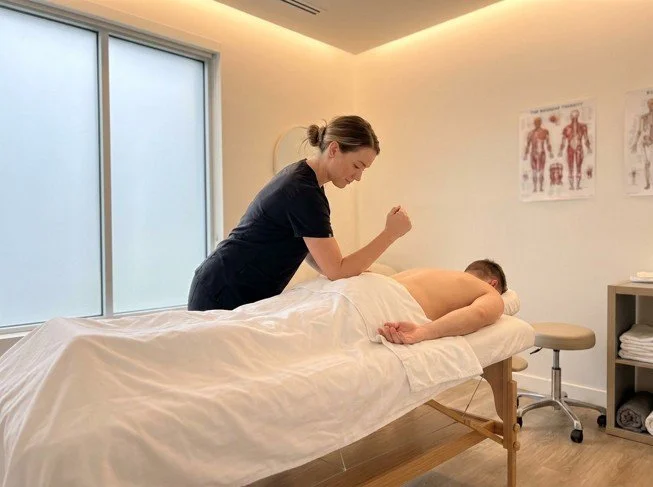
How Manual Therapy Addresses the Root Cause
Manual therapy does not treat nerves directly. What it does is reduce the mechanical and chemical load on the nerve by addressing the tissue and joint dysfunction creating that load.
For piriformis-driven sciatica, the priority is reducing the hypertonicity and adhesion in the gluteal region — particularly the piriformis, obturator internus, and gemelli. Sustained ischemic pressure, active-release techniques, and trigger point work break down adhesion patterns and allow the nervous system to downregulate its protective holding response.
For lumbar-origin sciatica, the approach involves working the paraspinal musculature, addressing thoracolumbar fascia restriction, and restoring mobility in the segments above and below the affected level. A 2015 systematic review in the Journal of Orthopaedic & Sports Physical Therapy found that manual therapy and exercise produced equivalent or superior outcomes to medical management alone for lumbar radiculopathy across short-, medium-, and long-term timeframes.
At ActiveBody in Sarasota, the first session for a sciatica client begins with a thorough movement assessment: how the low back loads and unloads, where the pelvis shifts during single-leg stance, and how hip rotation compares side to side. These findings shape the entire treatment plan.
What Sarasota's Active Adults Need to Know
The lifestyle of active adults in Sarasota creates a specific profile of sciatica risk. Extended desk work compresses the hip flexors. Golf produces asymmetrical rotational load on the lumbar spine and sacroiliac joints. Pickleball demands rapid lateral acceleration that stresses the hip rotators. Running concentrates load through the same structures thousands of times per session.
The resolution is not to stop the activity — it is to restore the tissue capacity and movement quality to handle the demands being placed on it. Corrective strength work targeting the hip abductors, deep rotators, and lumbopelvic stabilizers sustains the gains from hands-on therapy. The combination is far more durable than passive treatment alone.
When to Seek Further Evaluation
Seek immediate medical evaluation — not a massage appointment — if you experience any of the following:
• Saddle anesthesia — numbness in the inner thighs and groin
• Loss of bowel or bladder control combined with back or leg pain
• Rapidly progressing leg weakness — loss of motor function, not just pain
• Bilateral leg symptoms following a fall, accident, or acute spinal loading event
Frequently Asked Questions
Can massage actually help sciatica, or does it just mask the pain?
When sciatica originates from muscular compression — piriformis syndrome, gluteal hypertonicity, fascial restriction — manual therapy addresses the mechanical cause directly. For lumbar disc-related cases, it reduces the secondary tissue dysfunction amplifying the nerve irritation. The goal is structural change, not temporary relief.
How quickly should I expect improvement?
Most people notice a meaningful reduction in intensity within two to four sessions. The timeline depends on how long the pattern has been present and whether complementary movement work is being done between sessions.
Should I get an MRI before seeing a manual therapist?
Not necessarily. For new-onset sciatic symptoms without red flags, a thorough hands-on assessment is often more diagnostically useful in the short term than imaging — and significantly less expensive.
Is it safe to exercise with sciatica?
In most cases, yes — with appropriate modification. Complete rest is generally counterproductive. Gentle movement and targeted strengthening that does not reproduce radiating symptoms are typically beneficial.
Ready to Get to the Root of Your Sciatica?
Stop managing the pain. Start resolving it. Book your assessment at ActiveBody Functional Therapy today.
5500 Bee Ridge Road, Suite 102 | Sarasota, FL 34233
Call or text: 941-479-8849